
Movement + Recovery + Connection = Sustainable Performance
In a dance company, nobody calls it a system. You take class every morning. You rest your body on purpose, because you have to be able to do it all again tomorrow. And you spend your days with the same people, learning to move as one.
It took me leaving the stage to see what that was. Movement, recovery, and connection, built into the workday. Not a perk. The way the work gets done.
Most offices have the opposite setup, and the numbers show it.

Only 1 in 5 people is engaged at work
Global employee engagement fell to 20% in 2025, according to Gallup. Gallup estimates low engagement costs the world economy about $10 trillion in lost productivity, roughly 9% of global GDP.
Meanwhile, office workers spend around 60% of their working hours sitting, and 43% say they don't feel connected to their coworkers (the second number comes from a BetterUp survey, so treat it as directional).
Sitting still, running on empty, and feeling alone. That is the default setup for a lot of high performers.
What the research says about each pillar
Movement: short breaks lift energy, longer ones help more
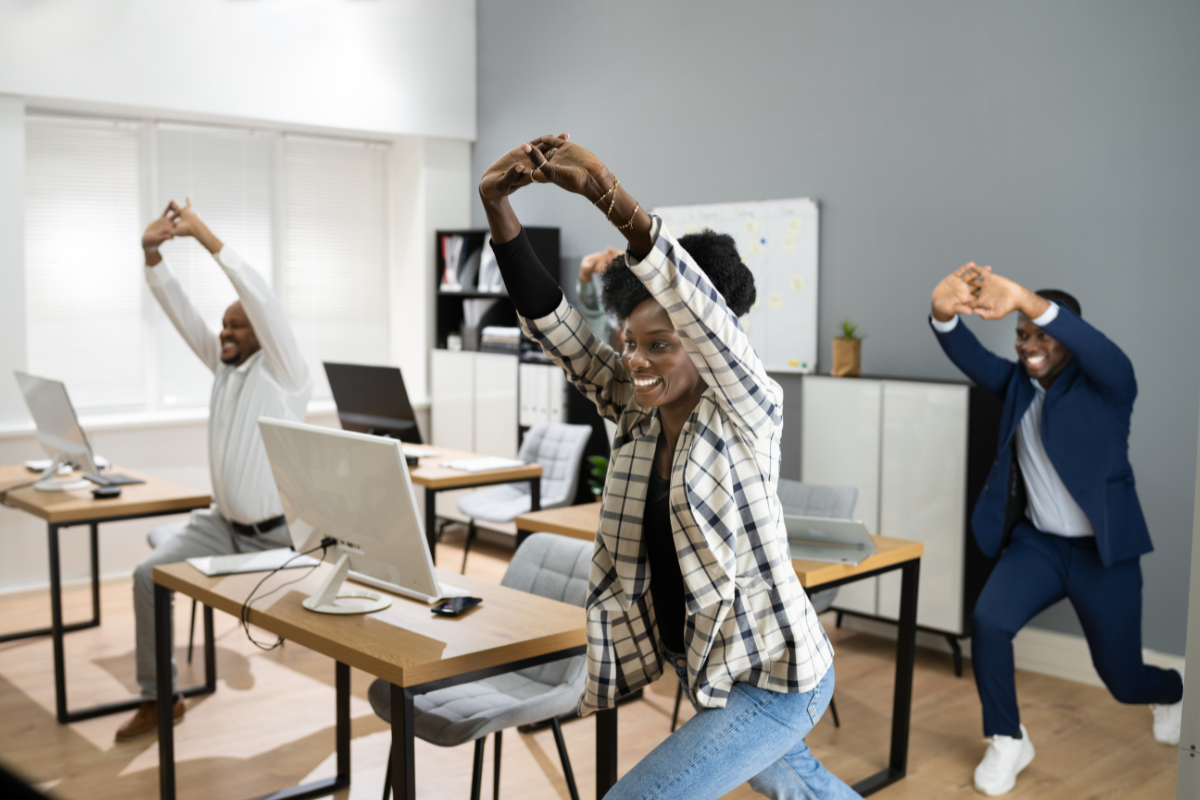
A meta-analysis of 22 studies in PLOS One found that micro-breaks of 10 minutes or less produced small but real gains in vigor and reductions in fatigue. The same review found no significant overall effect on performance, and noted that longer breaks gave a bigger boost. That is why we build our reset breaks at 15 minutes, not five.
Recovery: relaxing and learning something new are not wasted time
A meta-analysis of 316 samples and about 99,000 participants, published in the Journal of Business and Psychology, found that relaxation and mastery experiences (picking up a new skill, for example) predict engagement, performance, and creativity. Recovery is not the opposite of work. It is what makes the next stretch of work good.
Connection: loneliness is a performance problem
A meta-analysis in Occupational Medicine linked workplace loneliness to lower job performance (r = -0.35) and higher burnout (r = 0.39). And when movement happens together, it seems to bond people: in a nine-week field experiment at one publishing company, synchronous group movement was linked to stronger cohesion, lower work stress, and fewer sick days (Göritz and Rennung, 2019).
The honest part
No single study tests movement, recovery, and connection as a bundle. What we have is solid evidence for each one on its own, and early evidence that combined approaches to burnout tend to do better than single fixes (those reviews carry a high risk of bias, so we hold the claim loosely).
The publishing-company study is one company, and ours are often virtual sessions. We are not claiming a guarantee. We are building on what the research supports and measuring what happens with each team.
What this looks like at work
At The Triangle Sessions, the three pillars show up as a rhythm, not an event:
Monthly Reset Breaks: live 15-minute movement and recovery sessions your team can join from their desks.
The Performance Reset: a four-part quarterly series that goes deeper on each pillar.
Annual programs: a year of touchpoints for Charlotte teams and virtual teams, so the habit sticks.
We measure as we go, with surveys at the start, after sessions, and at the end of the year, so you can see what is changing for your team.
If you are planning 2027 and want your best people to stay and stay well, I would love to talk about what this could look like for your team. Book a call.
Sources
Gallup, global employee engagement report (2026): engagement 20% in 2025, about $10 trillion in lost productivity
Micro-breaks meta-analysis, PLOS One (22 studies)
Recovery experiences meta-analysis, Journal of Business and Psychology, 2022 (316 samples)
Workplace loneliness meta-analysis, Occupational Medicine, 2023
Sitting time and cognitive performance review, Frontiers in Physiology (about 60% of working hours sitting)
Göritz and Rennung, 2019, synchronous movement field experiment
BetterUp, workplace connection and well-being survey